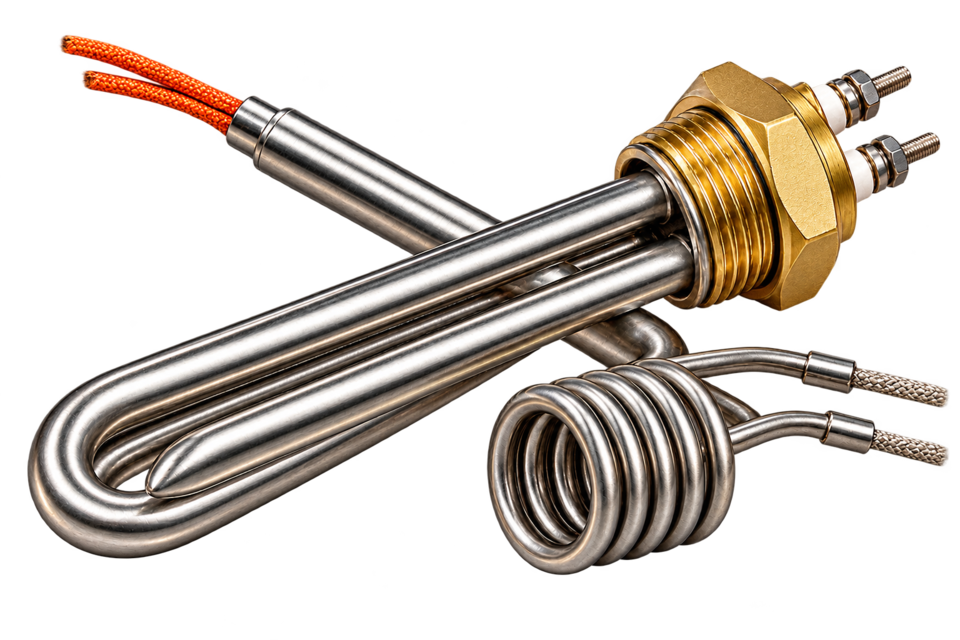
Annular two-legged electric heating tube rod designed for water vessels, distillers, and boilers.
Water Tank Heaters
Water tank heaters are designed to warm water in tanks, buckets, boilers and storage vessels. Available constructions include fixed tubular elements and replacement assemblies for domestic, commercial and industrial equipment.
Choose a model according to tank connection, voltage, power, element length and material. Ensure the element remains submerged and use suitable temperature and level controls where required.
Recommended
M-shape electric heating tube designed for water heating in cooking pots and buckets with 201 stainless steel construction.
Need an exact replacement?
Send dimensions, voltage, power, material, and photos. We’ll manufacture a heating element for your application.
Fill out the formCircle shape electric water heater pipe for water buckets, featuring 3KW power and stainless steel tube construction.
220V 2500W immersion heating element designed for water buckets and tanks, featuring a 220mm circle diameter and 10mm tube diameter.
Stainless steel immersion heating element for water heaters and boilers, featuring an integrated probe and durable tubular construction.
Electric boiling water heater heating pipe made of red copper, featuring an integrated flange and mounting holes for water heating applications.
304 stainless steel 2.5KW 220V water bucket heating element tube featuring a bend head and M16 mounting thread.
Electric tubular immersion heating element for open water buckets, featuring a bend head design and 220V operation.
Submersible low-voltage U-shaped heating tube with a waterproof wire, designed for small water tanks and liquid heating applications.
63mm triangle flange electric water heater element made of 201 stainless steel, designed for water tanks and dishwashers.
Copper circular heating element for water tanks and liquid boilers featuring a 220V 2KW specification and 12mm thread.
Frequently asked questions
Practical guidance for choosing and using products in this category.
Can an immersion heater be switched on without liquid?
An element designed for immersion must not be energised with its heated section exposed to air. Keep the required heated length covered by the specified liquid throughout operation, following the product instructions. Dry operation can cause rapid overheating and element failure.
Temperature control and suitable low-liquid-level protection should be part of the system design. Keep electrical terminals dry and have the installation checked by a qualified installer.
Are BSP, NPT and metric heater threads interchangeable?
No. These are different thread systems, and a similar diameter or nominal size does not mean the fittings will seal or fit correctly. Check the specified thread family, size, pitch and sealing arrangement on both the heater and the equipment.
DN is a nominal size designation, not a measured outside diameter. For example, do not select a mounting hole or adaptor from a DN label alone. If the thread cannot be positively identified, provide the equipment specification and clear measurements before ordering.
Is every stainless steel heater suitable for drinking water, brewing or pool water?
No. Suitability depends on the complete product, including the sheath, seals, fittings, liquid chemistry and operating conditions. A stainless steel grade by itself is not proof of food-contact, potable-water or pool suitability.
Choose a model whose documentation explicitly supports your application. For salt water, chlorinated water, food or drinking-water contact, confirm compatibility before ordering rather than relying on the product name or appearance.
Can an immersion heater run continuously?
Only when the selected model and the complete installation are rated for that duty. Continuous operation requires suitable heat removal, the specified liquid coverage, temperature control and protection against overheating or low liquid level.
Check the product duty rating and the tank or process requirements. A wattage rating alone does not confirm that a heater can run unattended or continuously in every installation.